Crypto Exchange Compliance in 2026: MiCA, the Travel Rule, and What Your Software Needs
October 25, 2026
A few years ago it was possible to launch a crypto exchange, start trading, and deal with licensing later. That window has mostly closed. In the EU the grace period is over, and the global anti-money laundering rules for crypto are being enforced in more countries every year.
This article explains what changed in 2026 and, more practically, which features your exchange software needs so that compliance doesn’t become a rebuild six months after launch.
It isn’t legal advice. Licensing depends on where your company is registered and where your users are, so you’ll need a local lawyer. What follows is the technical side that every jurisdiction ends up asking about.
MiCA: the EU grace period has ended
The EU’s Markets in Crypto-Assets Regulation (MiCA) introduced a single license for crypto-asset service providers, known as CASPs. Firms that were already operating under national rules got a transitional period to keep serving clients while they applied.
That period ended across the EU on 1 July 2026. ESMA, the EU’s markets regulator, made it clear that firms without MiCA authorization by that date had to wind down their services in an orderly way, and could keep holding client assets only as long as it took to exit. A pending application wasn’t enough to keep operating.
Several countries ended their transitional periods much earlier. According to Elliptic, the Netherlands, Finland, Latvia, Hungary, and Slovenia used six-month windows that closed on 30 June 2025, and Sweden’s nine-month window closed on 30 September 2025.
Around the deadline, Elliptic counted 213 CASP authorizations across 23 jurisdictions on ESMA’s interim register. Being on that register is now the simplest public test of whether a firm can serve EU clients. MiCA’s reach also extends beyond EU borders, so a company registered elsewhere isn’t automatically outside it if it serves EU users.
If you aren’t planning to apply for a MiCA license, your exchange needs to keep EU users out. That’s a technical requirement as much as a legal one.
The Travel Rule is spreading
The Travel Rule comes from FATF Recommendation 16. It requires exchanges and other virtual asset service providers to collect information about the sender and receiver of a crypto transfer and pass it to the provider on the other side, similar to how banks handle wire transfers.
FATF published its seventh update on crypto standards on 16 July 2026. It found that 83% of surveyed jurisdictions have now passed Travel Rule legislation, up from 73% in 2025. Enforcement is lagging: only 40% of the jurisdictions with that legislation have taken any supervisory or enforcement action so far. FATF named offshore providers, DeFi, unhosted wallets, and stablecoins as areas that need more attention.
Some countries apply the rule with no minimum amount. Sumsub reported that Australia’s updated AML/CTF rules bring in the Travel Rule from 1 July 2026 with no threshold, so it covers every transfer regardless of size.
For an exchange operator, the takeaway is simple. Even if your country isn’t enforcing the Travel Rule yet, your counterparties may be. A large exchange that has to send Travel Rule data on every withdrawal will start rejecting or delaying deposits from platforms that can’t receive it.
What your exchange software needs
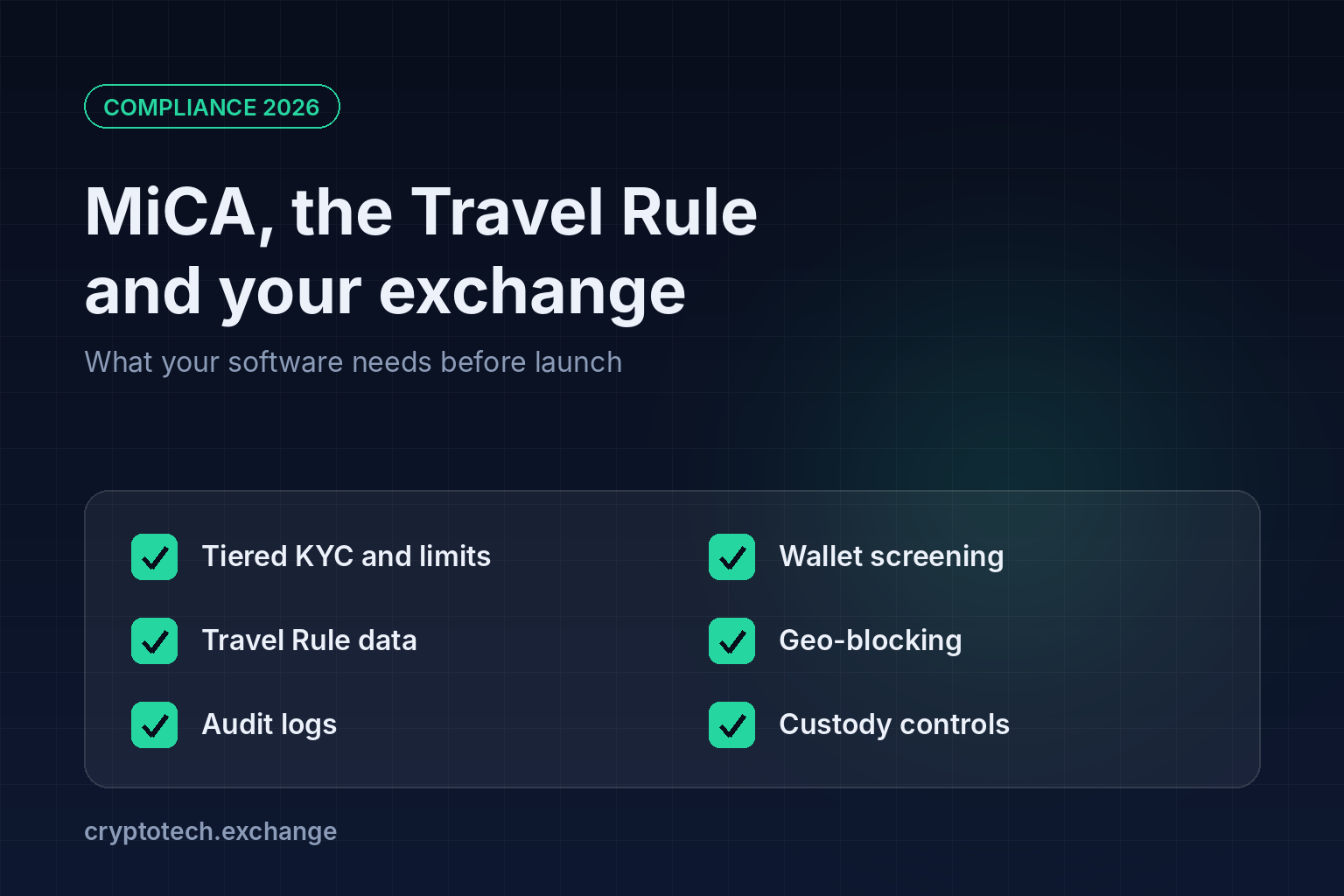
Regulators in different countries use different language, but they tend to ask about the same set of controls. These are the ones worth checking before you choose a platform.
Tiered KYC with limits
Users should be able to sign up and look around, but deposits, withdrawals, and trading limits should depend on verification level. Basic identity checks unlock small amounts. Proof of address and source-of-funds checks unlock larger ones. The limits need to be configurable from the admin panel, because they will change whenever your license conditions or local rules change.
A KYC and AML provider integration
Very few exchanges build identity verification themselves. You’ll connect to a provider that handles document checks, liveness checks, and sanctions and PEP screening. The integration should store the result and the reference ID on your side, so you can show an auditor who was verified, when, and by whom.
Transaction monitoring and wallet screening
Deposits and withdrawals should be checked against blockchain analytics, so you know when funds come from sanctioned addresses, mixers, darknet markets, or known scams. Flagged transactions need a review queue where a compliance officer can approve, hold, or reject them with a written reason.
Travel Rule support
You’ll need a way to collect beneficiary details on withdrawals, exchange data with other providers through a Travel Rule protocol or vendor, and record what was sent and received. Retrofitting this onto a withdrawal flow that wasn’t designed for it is painful, so plan for it early.
Geo-blocking
If you aren’t licensed in a country, you need to stop users from that country from signing up. That means filtering by IP and by the country on the user’s verified documents, since IP filtering alone is easy to get around with a VPN.
Audit logs and admin permissions
Every admin action, from approving a KYC check to changing a withdrawal limit, should be logged with who did it and when. Admin roles should be narrow: a support agent doesn’t need to approve withdrawals, and a compliance officer doesn’t need to change trading fees.
Custody controls
Regulators care about how client assets are held. Hot wallet limits, cold storage for the bulk of funds, multi-approval withdrawals for large amounts, and regular reconciliation between wallet balances and user balances all come up in license applications.
Why source code access matters here
Compliance requirements aren’t fixed. A regulator asks for a new report format, your KYC provider changes its API, a new country you want to serve has its own rules for limits. On a closed hosted platform you file a request with the vendor and wait. With the source code, your own developers can make the change.
CryptoTech exchange software comes with the full source code and already includes several of the controls above: KYC/AML provider integrations, two-factor authentication, withdrawal controls, rate limiting, encrypted storage of sensitive data, and country and IP filtering from the Standard package. The Enterprise package adds the Sumsub AML API, extended role-based access for admins, external fund storage with extra security, and Fireblocks custody integration.
Software alone doesn’t make an exchange compliant. You still need a license where one is required, written policies, and a compliance officer who actually reviews the flagged cases. Good software just means those people have the tools they need.
A pre-launch checklist
- Decide which countries you’ll serve, and get legal advice for each.
- Block every country you aren’t licensed for, by IP and by KYC document country.
- Set KYC tiers and limits that match your license conditions.
- Connect a KYC provider and a blockchain analytics provider before you open deposits.
- Plan how you’ll handle the Travel Rule, even if your country doesn’t enforce it yet.
- Restrict admin roles and turn on audit logging from day one.
- Write down your hot and cold wallet policy and test the reconciliation.
FAQ
Can I launch an exchange outside the EU and still serve EU users?
Since 1 July 2026, serving EU clients requires MiCA authorization. Being registered outside the EU doesn’t automatically put you outside MiCA’s scope. If you don’t hold a license, block EU users.
Does the Travel Rule apply to small transfers?
That depends on the country. FATF allows a threshold, but some countries apply the rule to every transfer. Australia is one example.
Is KYC needed for a P2P marketplace?
In most jurisdictions, yes. Holding crypto in escrow makes the platform a service provider in the trade, so the same KYC and monitoring duties usually apply.
Ready to plan a compliant launch? Look through the CryptoTech documentation, try the live demo, or compare packages on the pricing page.
Sources: ESMA statement on the end of MiCA transitional periods (17 April 2026); Elliptic, “What the end of MiCA’s transitional period means for crypto businesses” (June 2026); FATF, Seventh Targeted Update on Virtual Assets and VASPs (16 July 2026); Sumsub, “FATF Travel Rule: Crypto Compliance in 2026” (April 2026).