How a New Crypto Exchange Fixes the Empty Order Book Problem
October 25, 2026
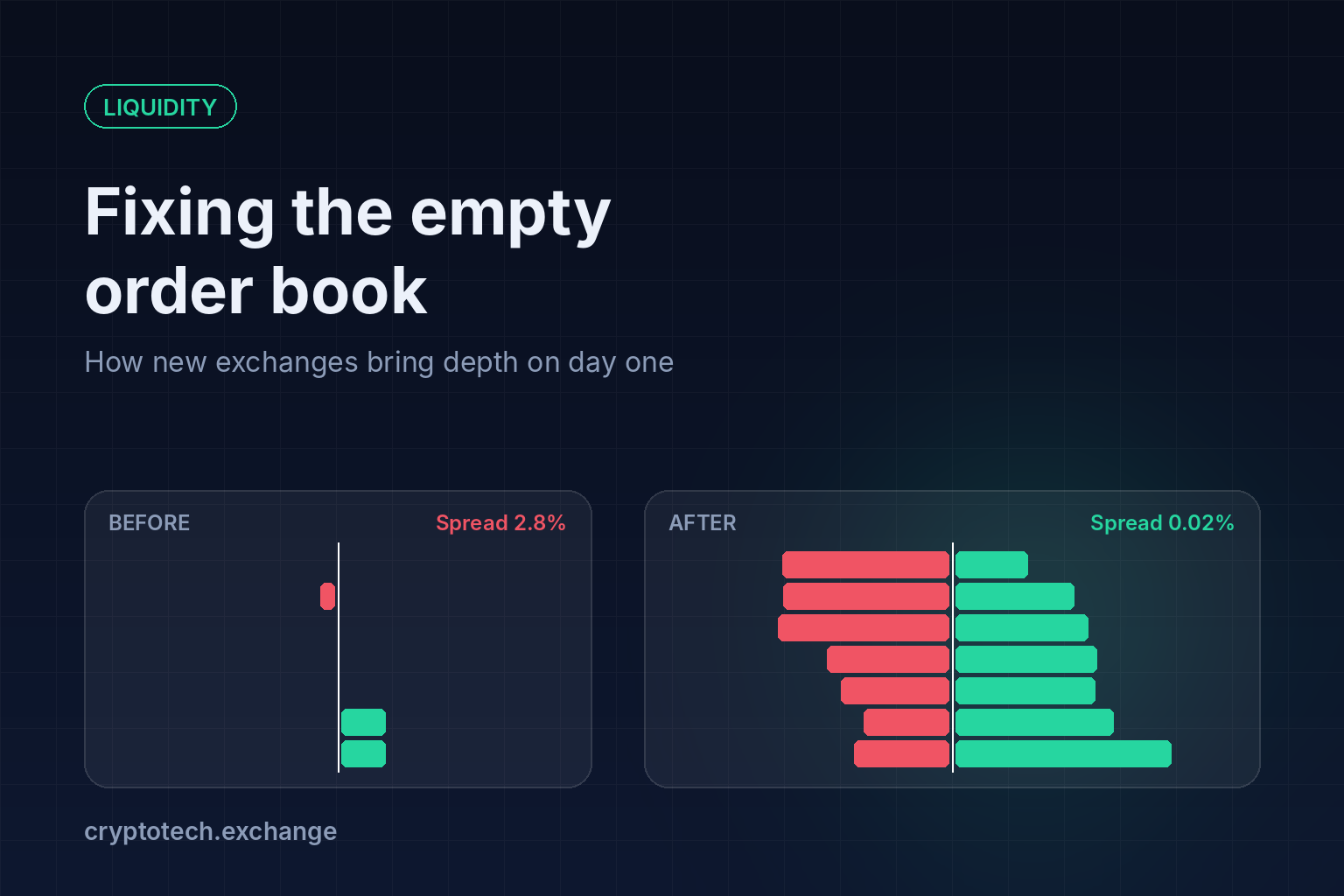
Most new exchanges don’t fail because the code breaks. They fail because the first hundred visitors open a trading pair, see a spread of three percent and an order book with six orders in it, and close the tab. They don’t come back.
Liquidity is a chicken-and-egg problem. Traders want depth before they arrive, and depth comes from traders. You can’t wait for it to sort itself out, so you have to bring liquidity in from somewhere on day one. There are four realistic ways to do that, and most operators end up combining two or three of them.

What a thin order book costs you
Start with the spread. If the best bid on BTC/USDT is 64,100 and the best ask is 65,900, a user pays almost 3% just to get in and back out. On a large exchange the same spread is a fraction of a cent, and your users know that.
Then there’s slippage. A market order for 2 BTC eats through every level of a shallow book and fills well away from the price the user saw on screen. A first fill like that is often the last trade a user makes with you.
With few participants, your last traded price can also drift away from the global market, and arbitrage bots will close that gap at your users’ expense. Listings suffer too. CoinMarketCap and CoinGecko both rate exchanges with their own scoring, and liquidity is part of what they look at.
Option 1: Aggregate liquidity from larger exchanges
This is the most common starting point. Your platform connects to one or more large exchanges through their APIs, pulls in their order book, and shows a scaled version of it to your users. When a user’s order fills on your exchange, the system places a matching order on the external venue to hedge the position.
Done well, your users see tight spreads and real depth from the first minute. Done badly, it loses money. A few things decide which one you get:
- Funded accounts on the external venue. Hedging needs balances there. If your BTC balance on the external exchange runs out during a busy hour, you’re left holding unhedged risk.
- Latency. Prices move between the moment your user trades and the moment your hedge lands. The gap is small on a good connection and painful on a bad one.
- API rate limits. External exchanges limit how often you can call them. Your bridge has to respect those limits without falling behind the market.
- Markup. Most operators add a small spread on top of the mirrored book. That markup pays for the hedging cost and is part of your revenue.
Aggregation works best for major pairs such as BTC, ETH, and the large stablecoins, where external books are deep and stable.
Option 2: Sign a market maker
A professional market maker places buy and sell orders on your books around the clock and keeps the spread within agreed limits. For new tokens and smaller pairs, where there is nothing to mirror, this is often the only serious option.
Market making deals vary a lot, so read the terms carefully. The questions worth asking:
- What maximum spread do they commit to, and at what depth (for example, $20,000 on each side within 1% of the mid price)?
- What uptime do they promise, and what happens if they miss it?
- Are they paid a monthly retainer, or do they take a token loan with options attached? Loan-and-option structures can leave a project’s token with heavy selling pressure later, so token issuers listing with you should understand them.
- Can you see their performance in reports, or do you have to trust them?
A good market maker will be fine with you monitoring their spread and depth from your own admin panel. A bad one will get vague when you ask.
Option 3: Run your own liquidity bot
Some operators keep a treasury and run their own bot that quotes both sides of the book. You keep the spread income and don’t depend on an outside firm.
The tradeoff is risk. When the market moves sharply in one direction, your bot keeps buying the falling asset or selling the rising one, and inventory piles up on the wrong side. Treat this as a trading business. It needs position limits, a kill switch, and someone watching it, not a script you set up once and forget.
Option 4: Launch with fewer pairs
This is the cheapest fix and the one founders skip most often. Fifteen pairs with real depth beat two hundred pairs with empty books. Users judge your whole exchange by the first pair they open.
Start with the pairs your target users actually trade, make them deep, and add more once volume justifies it. If your audience is in a specific region, a pair against the local fiat currency may matter more than another altcoin.
A word on fake volume
There’s always a temptation to make the exchange look busy with self-trading bots. Don’t. Wash trading is illegal in many jurisdictions, and it doesn’t fix the actual problem. A real trader who places a sizable order still hits a thin book and gets a bad fill. Price trackers and analysts have also become good at spotting volume that doesn’t match web traffic or order book depth.
If you want the exchange to look active, put that money into real depth through a market maker or a funded liquidity bridge.
How this works in CryptoTech
CryptoTech exchange software includes a liquidity module that connects your exchange to external exchanges, market makers, and liquidity providers for price feeds, order routing, and liquidity aggregation. Because you get the complete source code, your developers can change how the bridge hedges, which venues it uses, and how much markup it adds.
The Enterprise package also includes custom liquidity and trading bot development for operators who want to run their own market making. You can see what the trading side looks like on the live demo.
One honest caveat: software connects you to liquidity, it doesn’t create it. You still need funded external accounts or a commercial agreement with a market maker.
A simple launch plan
- Pick 10 to 20 pairs your users actually want.
- Mirror deep external books for the majors and fund your hedging accounts before launch.
- Sign a market maker for any pairs you can’t mirror, with written spread and depth commitments.
- Set alerts in your admin panel for spread width, hedge failures, and external balance levels.
- Add pairs only after the existing ones show steady organic volume.
FAQ
How much capital do I need for liquidity?
It depends on your pairs and how you source liquidity. Aggregation needs enough balance on the external venue to cover your largest expected net position. A market maker needs either a fee budget or a token loan. Work it out per pair rather than as a single number.
Can I launch without any external liquidity?
You can, but only if you already have an active community that will trade from day one, such as a token project’s existing holders. For a general exchange, an empty book at launch usually means a quiet exchange for a long time.
Does liquidity aggregation work for new tokens?
Usually not. If a token isn’t listed on any large exchange, there’s no external book to mirror. New tokens need a market maker or the project’s own liquidity.
Want to see the liquidity setup in practice? Try the CryptoTech live demo or compare packages on the pricing page.