How to Choose Crypto Exchange Software: 12 Questions to Ask Before You Buy
November 26, 2026
Exchange software is the biggest technical decision you will make when you launch a crypto exchange. It decides how fast you can go live, what you can change later, how secure your users’ funds are and how much you will pay every year. Sales pages all look similar, so the best way to compare vendors is to ask the same direct questions of each one.
Below are twelve questions we recommend asking. For each one we explain why it matters, what a good answer looks like, and how CryptoTech answers it.
Licensing and ownership
1. Do I get the full source code?
Without the source code, you depend on the vendor for every change, every bug fix and every new market. If the vendor raises prices, changes direction or shuts down, your exchange is at risk. Our guide to white label vs full source code covers the trade-offs in detail.
CryptoTech: every package includes source code access. You can change the code, add features and hire any developer to work on it.
2. Is the licence a one-time payment, a subscription or a revenue share?
Monthly licence fees and revenue shares look cheap at launch and become expensive as you grow. Ask for the total cost over three years at your target volume.
CryptoTech: a one-time licence per domain, with no recurring licence fee and no revenue share. Packages range from $990 (Spot Exchange) to $9,990 (Enterprise, with unlimited domains). See pricing.
3. Where is the exchange hosted, and who controls the servers?
Self-hosting means you control your data, your infrastructure costs and your regulatory footprint. Vendor-hosted platforms can be faster to start but harder to leave.
CryptoTech: you install the platform on your own servers. Installation is free from the Derivatives package upwards and typically takes 1 to 2 days (3 to 4 days for Enterprise).
Technology and performance
4. How fast is the matching engine, really?
Ask for orders per second and latency under load, and ask how the engine behaves during a volatility spike. Our explainer on how a matching engine works explains what to look for.
CryptoTech: the standard engine handles high-volume spot and futures markets. Enterprise adds an optional Rust matching engine rated at up to 700,000 orders per second. The full stack is on our tech stack page.
5. Which blockchains and tokens are supported out of the box?
Every network you add later costs development time. Check native support for the chains your users actually use, and how new tokens are listed.
CryptoTech: Bitcoin (with BRC-20), Ethereum, BNB Chain, Polygon, TRON, Solana, TON and XRP Ledger, with Arbitrum, Optimism, Fantom, Cronos, Celo and NEAR on Enterprise. Any token on these networks can be listed by contract address.
6. Which trading products are included?
Make a list of the products you need at launch and in year two, then check which ones are included and which are paid add-ons.
CryptoTech: spot, swap, options, perpetual futures, margin, trading bots, copy trading, P2P, merchant payments, staking and a launchpad, depending on the package.
Security and compliance
7. How are user funds protected?
Ask specifically about hot and cold wallet separation, withdrawal controls and account security. Vague answers here are a red flag.
CryptoTech: 2FA and passkeys, withdrawal holds, address whitelists, anti-phishing codes and cold storage are built in. Details are on the security page.
8. What KYC, AML and compliance tooling is included?
Regulators and banking partners will ask how you verify users and monitor transactions. Read our guide to MiCA and the Travel Rule before you choose.
CryptoTech: KYC/AML integrations, KYC review and withdrawal approval are managed from the admin panel, with staff roles to control who can approve what.
Launch and operations
9. How will my order books look on day one?
A new exchange with empty order books loses users immediately. Ask how the vendor solves this. Our article on the empty order book problem covers the options.
CryptoTech: liquidity connectivity mirrors order books from Binance in real time, so markets are full from the first day.
10. Can I see it working before I buy?
A live demo with real screens, including the admin panel, tells you more than any brochure. Also ask for platforms already running on the software.
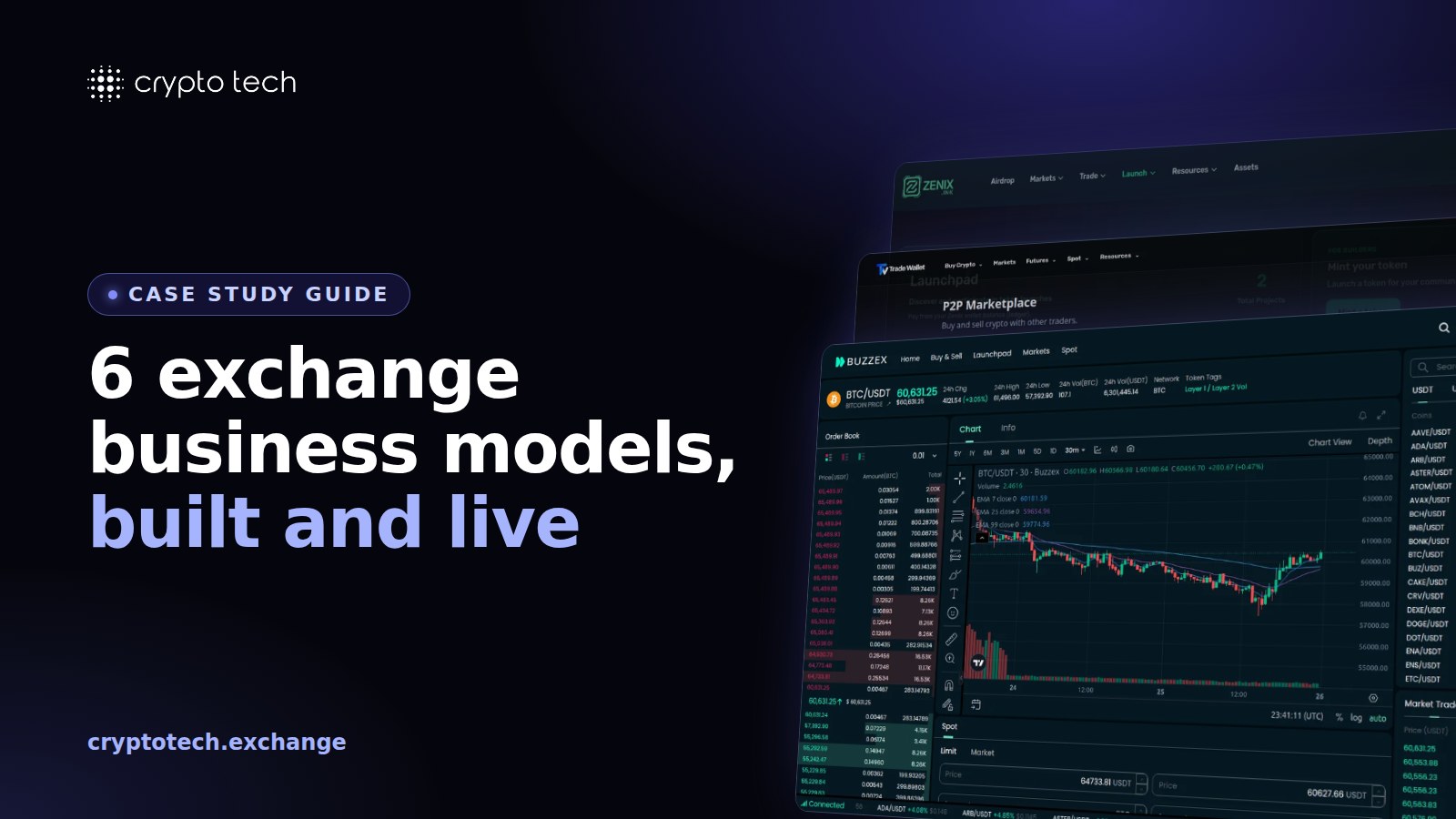
CryptoTech: the live demo has a prefilled sign-in and includes the admin panel. You can also read about live platforms such as Buzzex, Zenix, TradeWallet and 1Gogh in our case studies.
11. What do the mobile apps cover?
Most retail trading now happens on phones. Check whether the apps are native, whether they share the same backend, and which features they include.
CryptoTech: native Android and iOS apps built with Flutter on the same backend as the website. See mobile apps.
12. What support do I get after launch?
Find out what is included, how quickly tickets are answered and what ongoing updates cost.
CryptoTech: a ticket desk from the day of purchase. Ongoing support with updates is optional at $1,000 per month, and Enterprise includes prioritized support. Owner documentation covers installation and every admin screen and setting.
A quick scoring checklist
| Question | Good answer | Red flag |
|---|---|---|
| Source code | Full code included | Code held by vendor |
| Licence | One-time, no revenue share | Monthly fee plus % of revenue |
| Hosting | Your own servers | Vendor-only hosting |
| Performance | Published orders/second and latency | “Very fast” with no numbers |
| Security | Cold storage, withdrawal controls, 2FA | No clear wallet architecture |
| Liquidity | Built-in order book connectivity | “You will need a market maker” |
| Proof | Live demo and live client platforms | Screenshots only |
Next steps
Send these twelve questions to every vendor on your shortlist and compare the answers side by side. If you want to see how CryptoTech answers them in practice, try the live demo, read our client case studies and compare packages on the pricing page. For the full picture of what launching involves, read how to start a cryptocurrency exchange in 2026.