6 Crypto Exchange Business Models (With Real Platforms Built on CryptoTech)
November 26, 2026
“Crypto exchange” covers very different businesses. A retail spot exchange, a P2P marketplace, a token launchpad and a 100x futures venue share a matching engine and a wallet system, but they win customers in different ways, carry different risks and need different modules. Choosing the model first saves months of building features your users will never touch.
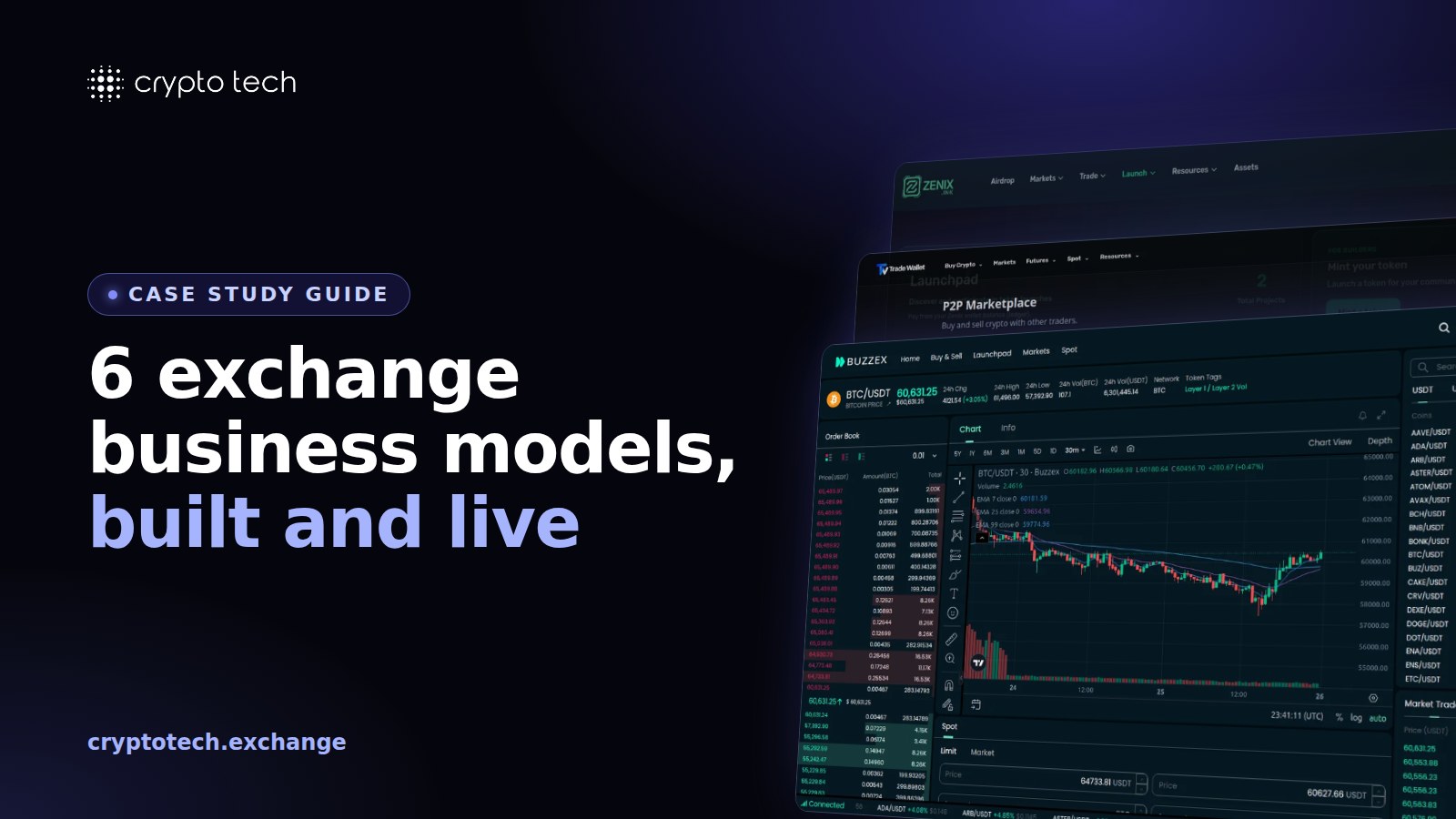
This guide walks through six exchange business models using real platforms that run on CryptoTech software: Buzzex, Zenix, TradeWallet, 1Gogh, B2Z Exchange, ASTX, Vcobit and Yex. For each model you will see who it serves, how it earns, which modules it needs and what to watch out for. The full write-ups are on our case studies page.
The six models at a glance
| Model | Main revenue | Core modules | Example platforms |
|---|---|---|---|
| Retail spot exchange | Trading fees, listing fees | Spot engine, wallets, fiat on/off ramp | Buzzex, Vcobit |
| Token launch platform | Launch fees, trading fees | Launchpad, token minting, staking, swap | Zenix |
| Exchange + P2P marketplace | P2P maker/taker fees, trading fees | P2P escrow, chat, appeals, spot | TradeWallet |
| Exchange + payments | Card, top-up and payment fees, trading fees | Spot, KYC/AML, cards, QR payments | 1Gogh |
| Derivatives exchange | Futures fees, funding | Perpetual futures, margin, copy trading | B2Z Exchange, ASTX |
| Full-suite exchange | All of the above | Spot, futures, bots, copy trading, earn | Yex |
1. Retail spot exchange
A retail spot exchange is the classic model: users deposit crypto or fiat, buy and sell against USDT or another quote currency, and withdraw. Revenue comes from trading fees and, as the exchange grows, from listing fees paid by projects.
Who it suits: operators with a specific audience, such as a country, a language community or a trading niche, who want a simple product they can explain in one sentence.
In production: Buzzex and Vcobit
Buzzex pairs a pro spot terminal with a simple Buy & Sell flow and fiat on/off-ramp, so a first-time buyer and an active trader use the same account. It lists 50+ coins, runs a New Listings feed and a Launchpad, and has its own BUZ token. Vcobit deliberately avoids leverage. It offers Basic and Advanced trading views, a published 0.05% fee, Simple Earn and nine interface languages.
What to get right
- Liquidity from day one. An empty order book drives new users away. Connect external liquidity so the main markets look deep before your own volume arrives.
- Onboarding. Fiat on-ramp, clear KYC steps and a “buy in two clicks” path matter more than advanced order types for retail users.
- Listings as a growth channel. A New Listings feed and a launchpad give traders a reason to come back.
2. Token launch platform
A launch platform earns when new projects raise funds and list their tokens. The product is trust: holders need to believe that liquidity will not disappear the day after a launch.
In production: Zenix
Zenix combines a launchpad with mandatory on-chain liquidity locking and a self-service “Mint a token” flow. Newly launched tokens trade immediately on Zenix’s own spot markets and Quick Buy swap. Holders can stake with streaming reward pools or flat-APY products on 90, 180 or 365-day locks, and an airdrop module lets users register a wallet before launch.
What to get right
- Protection rules enforced by the software, not by promises: locked liquidity, hard caps and per-user limits.
- A place to trade straight after the sale. Without a market, buyers sell elsewhere and the launch loses momentum.
- Reasons to hold, such as staking and airdrops, so tokens do not all hit the order book at once.
3. Exchange + P2P marketplace
In many markets, bank cards and payment processors do not work well for crypto. A P2P marketplace lets users trade with each other using local payment methods, while the exchange holds the crypto in escrow. The operator earns maker and taker fees on each P2P order and keeps users inside the ecosystem for spot trading.
In production: TradeWallet
TradeWallet runs spot markets next to a P2P marketplace with buy and sell ads, in-trade chat and escrow that stays locked until a trade is released or cancelled. Balances are split into Funding and Trading accounts, registration does not require KYC, and a published fees-and-limits schedule shows users what they will receive before they confirm a withdrawal.
What to get right
- Dispute handling. Appeals with evidence uploads and staff review are what make strangers willing to trade.
- Payment-method flexibility. The admin panel should let you add local banks and mobile wallets without code changes.
- Merchant verification, so high-volume traders are identified and accountable.
4. Exchange + payments ecosystem
This model treats the exchange as the engine behind a wider financial product. Users trade, but they also spend: by card, by QR code or by bank payout. Revenue comes from trading fees plus card issuing, top-up and payment fees.
In production: 1Gogh
1Gogh offers 14 spot pairs against USDT, including Tether Gold, and lets the same USDT balance fund three virtual USD cards (two on Mastercard, one on Visa), QR ScanPay in 6+ countries and local bank payouts. Onboarding uses Sumsub KYC with AML/CFT monitoring, and the platform is available on the web, on Android and as a Telegram Mini App.
What to get right
- Compliance first. Card and payment partners will ask about KYC, AML monitoring and wallet segregation before anything else. See our guide to crypto exchange compliance in 2026.
- One balance. Users should not move funds between “exchange” and “wallet” products to pay for something.
- Distribution channels such as mobile apps and messenger mini apps, because payments happen on phones.
5. Derivatives exchange
Derivatives venues earn the highest fees per active user, but they carry the most risk. Perpetual futures need a mark price, funding payments, liquidation logic and an insurance fund that hold up in a volatile market.
In production: B2Z Exchange and ASTX
B2Z Exchange runs futures up to 100x with multi-asset margin and settlement, lists crypto, stock and commodity contracts, and adds Express Buy, OTC, bot copy trading and an AutoTrader. ASTX focuses on USDT-margined perpetuals up to 50x on a unified margin account, plus event contracts, futures copy trading and agent programs.
What to get right
- Fair liquidations. Use a mark price, not the last trade, to trigger liquidations. Our article on mark price vs last price explains why.
- Margin modes. Offer both cross and isolated margin so users can control risk per position.
- Social features. Copy trading turns your best traders into a marketing channel.
6. Full-suite exchange
Some operators want to compete with tier-one exchanges on product range from the start. The upside is that every type of trader finds what they need. The cost is complexity: more products to support, more risk settings to tune and more to explain to users.
In production: Yex
Yex offers spot and margin trading, USDⓢ-M and Coin-M perpetual futures, AI or manual spot grid and futures grid trading bots, spot and futures copy trading, staking, crypto loans, rewards and trading competitions, in 12 languages.
What to get right
- Launch in stages. Even a full-suite exchange should open spot first, then add futures and earn products once operations are stable.
- One admin panel for users, risk, fees and withdrawals across every product. See the CryptoTech admin panel.
How to choose your model
- Start from your audience, not from features. Who will use the exchange, and what do they struggle with today: buying crypto at all, trading with leverage, paying with crypto or launching a token?
- Check your licensing path. Derivatives and payments face the strictest rules in most jurisdictions. Spot and P2P are usually simpler starting points.
- Pick the smallest model that serves that audience, and plan the next module you will add once you have users.
- Make sure your software can grow with you. With full source code, every module above is a configuration choice, not a new vendor.
Build any of these models with CryptoTech
Every platform in this guide runs on the same CryptoTech core: a high-performance matching engine, multi-currency wallets, an admin panel, KYC/AML integrations, liquidity connectivity and REST and WebSocket APIs. You receive the complete source code under a one-time licence, host it on your own servers and enable the modules your model needs. Compare packages on the pricing page, read the full case studies, or try the live demo.