Mark Price vs Last Price: How Crypto Futures Exchanges Prevent Unfair Liquidations
November 1, 2026
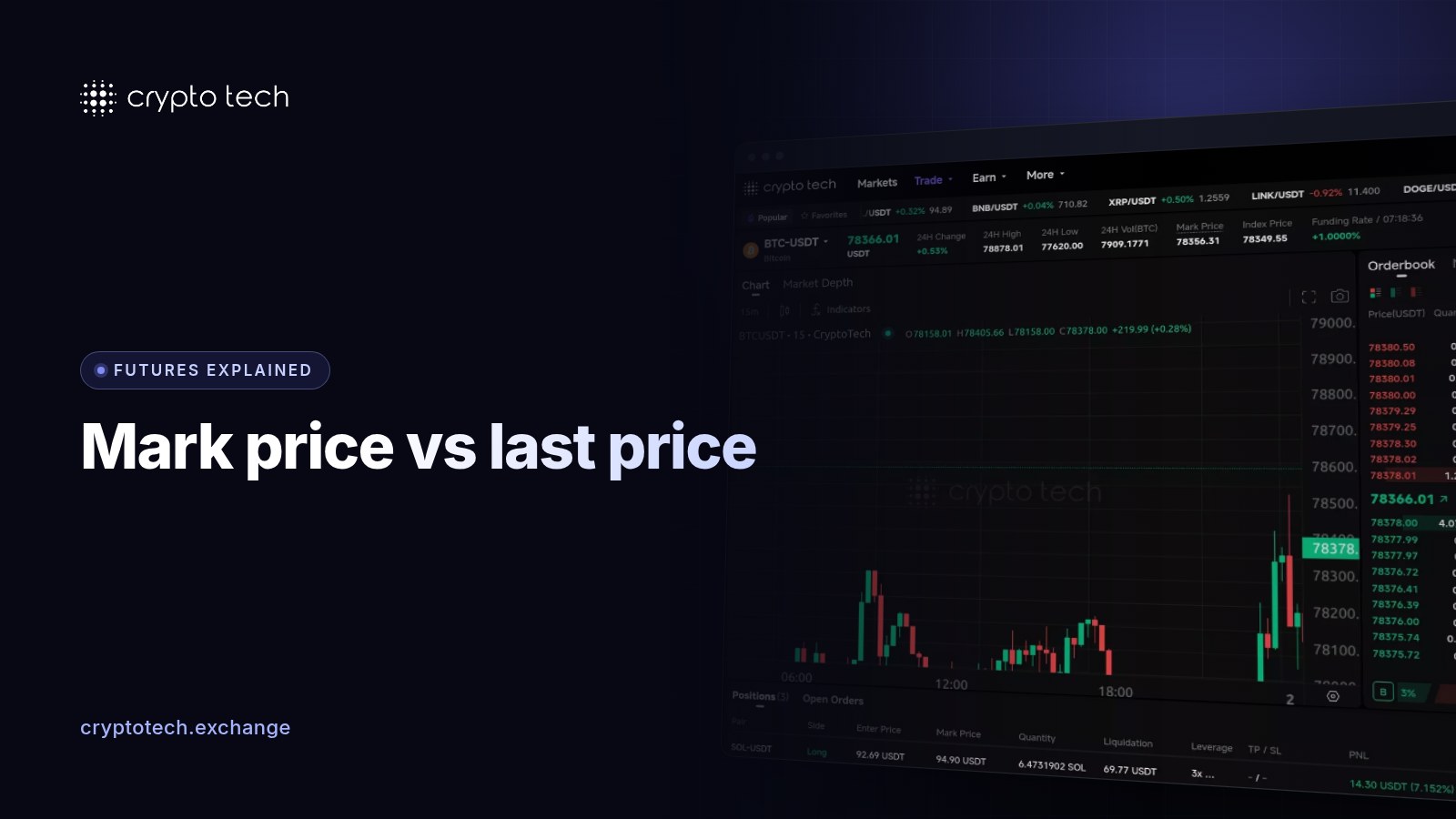
Open a futures screen on any large exchange and you will see two prices that are almost the same: the last price and the mark price. Most traders ignore the difference until a position is liquidated at a price they never saw on the chart. This article explains what mark price is, how it is calculated and why every serious futures exchange uses it.
What is the last price?
The last price is the price of the most recent trade on that exchange. It is real, but it is also easy to move. On a thin order book one large market order can push it several percent for a moment before arbitrage brings it back.
What is the mark price?
The mark price is an estimate of the fair value of a contract. Exchanges use it for two things:
- Liquidations. A position is liquidated when the mark price, not the last price, reaches its liquidation price.
- Unrealised profit and loss. The PnL shown on open positions is calculated at the mark price.
Orders still fill at the last price. Mark price only decides when risk rules apply.
How mark price is calculated
Details differ between exchanges, but most follow the same two steps.
Step 1: the index price
The index price is the spot price of the asset taken from several large exchanges. Using a median rather than an average means one exchange with a bad print cannot drag the index. Sources that drift too far from the others are ignored.
Step 2: a smoothed basis
Futures often trade slightly above or below spot. That gap is called the basis. The exchange adds a moving average of the basis to the index, so the mark price follows the futures market’s normal premium without reacting to a single spike.
Mark price = index price + moving average of (last price minus index price)
A worked example
Suppose BTC trades around 70,000 on the major spot exchanges and your futures market usually sits 30 dollars above that. A trader holds a 20x long with a liquidation price of 66,800.
- A whale sells into a thin book and the last price touches 66,500 for two seconds.
- The index is still about 70,000, because spot markets elsewhere did not move.
- The smoothed basis barely changes, because two seconds is a tiny part of the averaging window.
- The mark price stays near 70,030, so the position is not liquidated.
Without a mark price, that trader would have lost the position to a move that was over before anyone could react.
Why this matters for exchange operators
For an operator, liquidations based on the last price are a reputation risk. Traders share screenshots of “scam wicks” quickly, and a young exchange cannot afford that. A mark price also protects the exchange itself: it makes the platform harder to manipulate by someone who pushes the price on purpose to trigger liquidations.
Mark price and the insurance fund
When a position is liquidated, it is closed at market. If the close happens at a better price than the bankruptcy price, the surplus goes to an insurance fund. If it happens at a worse price, the fund covers the shortfall. A visible insurance fund balance tells traders the exchange can absorb bad liquidations without passing the loss to them.
How CryptoTech implements mark price
- The index is the median of the spot price on Binance, OKX, Bybit and MEXC, and sources that drift too far are dropped.
- The mark price adds an exponential moving average of the basis over a window the operator sets, five minutes by default.
- If no external price is available, the mark price falls back to a smoothed average of the exchange’s own last price.
- Isolated and cross liquidations, unrealised PnL and funding fees all use the mark price. Fills, take-profit and stop-loss use the last price.
- Every liquidation surplus or shortfall is recorded in an insurance fund ledger with a public page showing the balance.
The trading screen shows mark and index prices next to the last price, so traders can see exactly what their risk is measured against.
Frequently asked questions
Why was I liquidated when the chart never reached my liquidation price?
The chart shows the last price. Liquidation uses the mark price, which can differ slightly. Switch the chart to mark price, if your exchange offers it, to see the line that matters.
Does mark price affect the price my order fills at?
No. Orders fill against the order book at the last traded prices. Mark price is used for risk checks and PnL.
Can mark price be manipulated?
It is much harder than manipulating the last price, because it depends on several outside exchanges and a time-averaged basis.
Read next: how funding rates keep perpetual futures close to spot, or see the futures exchange software in action.