How Much Does It Cost to Start a Crypto Exchange in 2026?
November 2, 2026
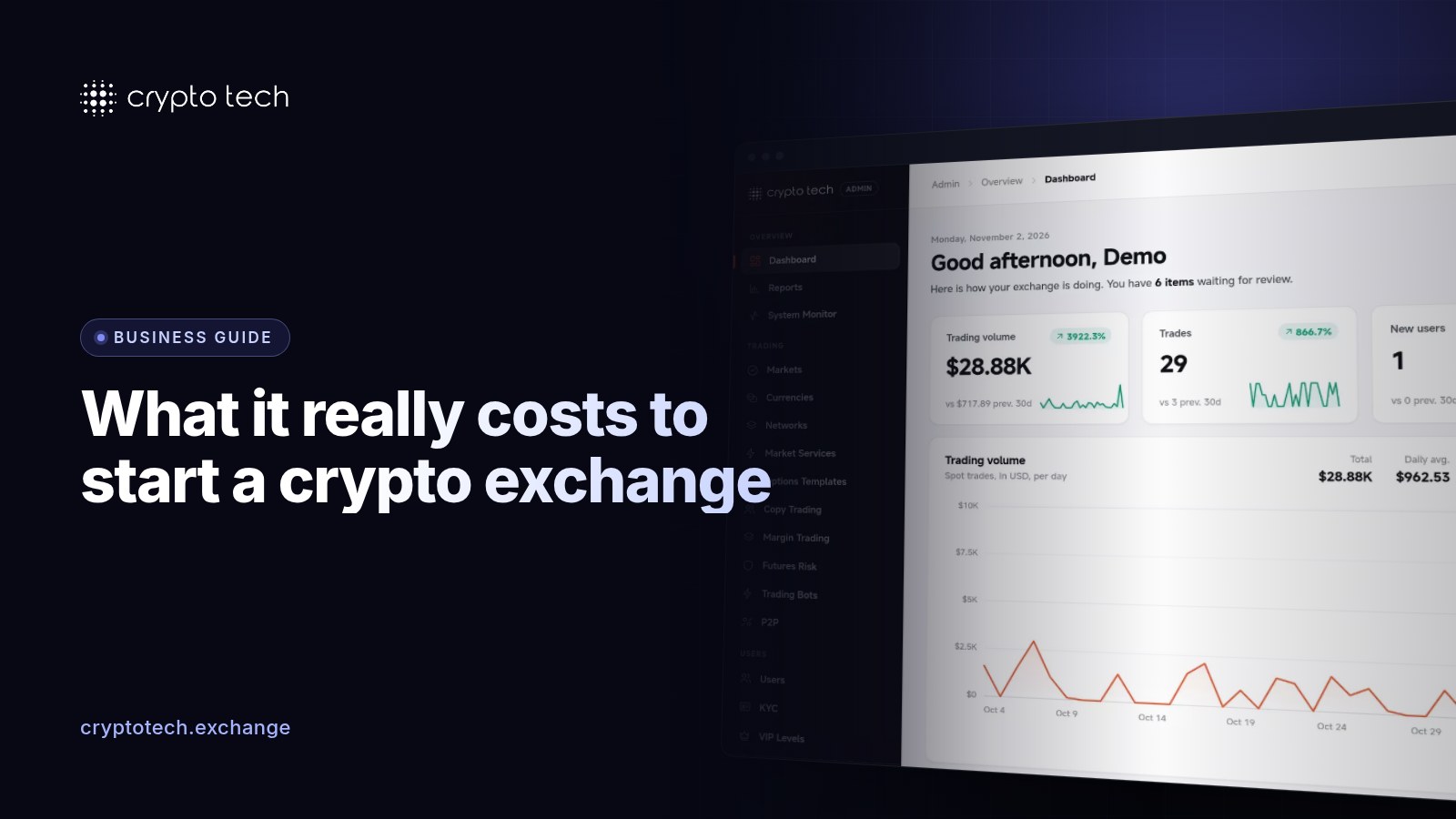
Ask five vendors what a crypto exchange costs and you will hear five numbers, from a few hundred dollars to several million. They are all describing different things. One is selling a script, another a hosted white label with a monthly fee, another a team that writes everything from scratch.
This guide breaks the budget into the lines you will actually pay for, so you can price your own plan instead of someone else’s.
The short answer
The software is rarely the biggest cost. For most new exchanges the budget splits into three parts:
- One-time costs: the software licence, installation, company setup and legal advice.
- Fixed monthly costs: servers, support, the people who run the exchange and the tools they use.
- Costs that grow with users: identity checks, SMS messages, blockchain fees and marketing.
The first part is where buyers spend most of their research time. The third part is where most of the money goes once the exchange is live.
1. Exchange software: build, rent or buy
There are three ways to get the software, and they lead to very different budgets.
| Option | How you pay | What to watch |
|---|---|---|
| Build from scratch | Salaries of an engineering team for a year or more | The matching engine, wallets and security take longest. Bugs in them cost real money. |
| White-label SaaS | Setup fee plus a monthly fee, often plus a share of trading revenue | You do not own the code, and the vendor controls your roadmap and your data. |
| Licensed source code | A one-time licence, then optional support | You host it yourself, so you need someone to look after the servers. |
To estimate a build from scratch, multiply the team by the time. A realistic first version needs backend, frontend, blockchain, mobile and security engineers, plus someone testing. Five or six people for twelve months is a modest plan. Apply your local salaries and you have the number, before the first user signs up.
If you go with licensed code, the price depends on the modules you need. As an example, CryptoTech packages are one-time licences per domain:
| Package | One-time licence | Typical use |
|---|---|---|
| Basic | $490 | Spot exchange, 20 pairs, API and listing endpoints |
| Starter | $1,290 | Adds fiat, bank and card payments, ERC-20, 11 languages, referrals |
| Standard | $2,990 | Adds the liquidity module, social sign-in and free installation |
| Business | $8,990 | Adds futures, options, swap, 8 networks, launchpad and staking |
| Enterprise | Quote | Unlimited domains, P2P, merchant payments, mobile apps, custody tools |
Our article on white label vs full source code goes deeper into that choice.
2. Installation and setup
Someone has to install the platform, connect the blockchain nodes and configure the background services. If your team has done it before, this is a few days of work. If not, pay the vendor. With CryptoTech, installation is free from the Standard package and a one-time $250 for Basic and Starter.
3. Servers and blockchain nodes
A self-hosted exchange runs on servers you rent. A small exchange starts on one machine with 4 to 8 GB of memory, 2 to 4 CPUs and an SSD of 100 to 250 GB. Servers of that size cost tens of dollars a month at most hosting companies.
Costs grow when you add:
- Your own blockchain nodes. A Bitcoin full node needs hundreds of gigabytes of disk. For other networks you can use a node provider instead, which is cheaper at the start.
- A separate database server and backups once volume grows.
- Cloudflare or a similar service in front of the site for DDoS protection. A free plan is enough to start.
4. Identity checks, SMS and email
These are the costs that grow with every new user.
- KYC. You can review ID documents yourself in the admin panel, which costs staff time, or use a provider such as Sumsub, which charges per verification.
- SMS. Phone sign-up and SMS two-factor codes go through a provider like Twilio, paid per message. Prices vary a lot by country.
- Email. Transactional email services charge by volume and are cheap at the start.
Budget them per user, not per month. If you plan a marketing push, these lines grow with it.
5. Custody and wallets
Every exchange needs hot wallets for withdrawals. Keep most funds in cold storage: wallets whose keys never touch the server. A simple setup uses rules that move funds from the hot wallet to a cold address once a threshold is reached, and costs nothing extra.
Larger operators use an institutional custody provider such as Fireblocks. That adds a significant annual fee but gives you approval policies and insurance options. Read hot wallet vs cold wallet for the basics.
6. Legal, licensing and company setup
This line varies more than any other, from a few thousand dollars to a large share of the total budget. It depends on the countries you serve, whether you hold customer fiat, and which licence applies. In the EU, MiCA now sets the rules. Our guide to crypto exchange compliance in 2026 lists what regulators expect from the software.
Get legal advice before you spend on anything else. The country you pick decides which payment providers, banks and liquidity sources will work with you.
7. Liquidity
An exchange with empty order books does not convert visitors. You have three options:
- Mirror an external order book. A liquidity module copies the book of a large exchange in real time. It is part of the software and has no running fee.
- Hire a market maker. Professional market makers charge a monthly retainer, a loan of tokens, or both.
- Run your own bot with your own capital.
We explain the trade-offs in how a new exchange fixes the empty order book problem.
8. People
Even a small exchange needs someone to:
- answer support tickets and review KYC documents
- approve withdrawals and watch for fraud
- look after the servers and apply updates
- handle compliance and reporting
At launch, two or three people can share these roles. If nobody on your team manages Linux servers, an external support plan is cheaper than a full-time hire. CryptoTech support with updates is an optional $1,000 per month.
9. Marketing
This is the line founders underestimate most. Traders need a reason to move from the exchange they already use. Budget for content and search, listings on CoinMarketCap and CoinGecko, a referral program and launch campaigns such as airdrops or trading competitions.
A lean launch budget, line by line
| Cost | When you pay | Notes |
|---|---|---|
| Software licence | Once | Choose the package that fits your first year, upgrade later |
| Installation | Once | Free from Standard upwards |
| Company and legal | Once, then yearly | Depends on country and licence |
| Servers | Monthly | One server to start |
| Support plan | Monthly, optional | Or an in-house server admin |
| KYC, SMS, email | Per user | Grows with sign-ups |
| Staff | Monthly | Support, compliance, operations |
| Marketing | Monthly | The line that decides growth |
How to keep costs down
- Start with the modules you need. You can add futures, P2P or mobile apps later on the same installation.
- Use mirrored liquidity at launch and bring in a market maker when volume justifies it.
- Review KYC in-house until volume makes a provider cheaper than staff time.
- Use node providers for most networks and run your own Bitcoin node only when you need it.
- Test everything on the live demo before you buy, so you pay for the right package once.
Frequently asked questions
Can I start a crypto exchange for under $10,000?
The software and servers can fit in that budget. Legal costs, staff and marketing usually do not, so plan them separately.
Is a monthly white label cheaper than buying the code?
For the first few months, sometimes. Over two or three years, a monthly fee plus a revenue share usually costs more than a one-time licence, and you still do not own the code.
What is the biggest hidden cost?
People. Support, compliance and operations run every day, while the software is paid once.
Ready to price your own plan? Compare the packages or see the whole crypto exchange software platform.