How to Get Your Crypto Exchange Listed on CoinMarketCap and CoinGecko
November 2, 2026
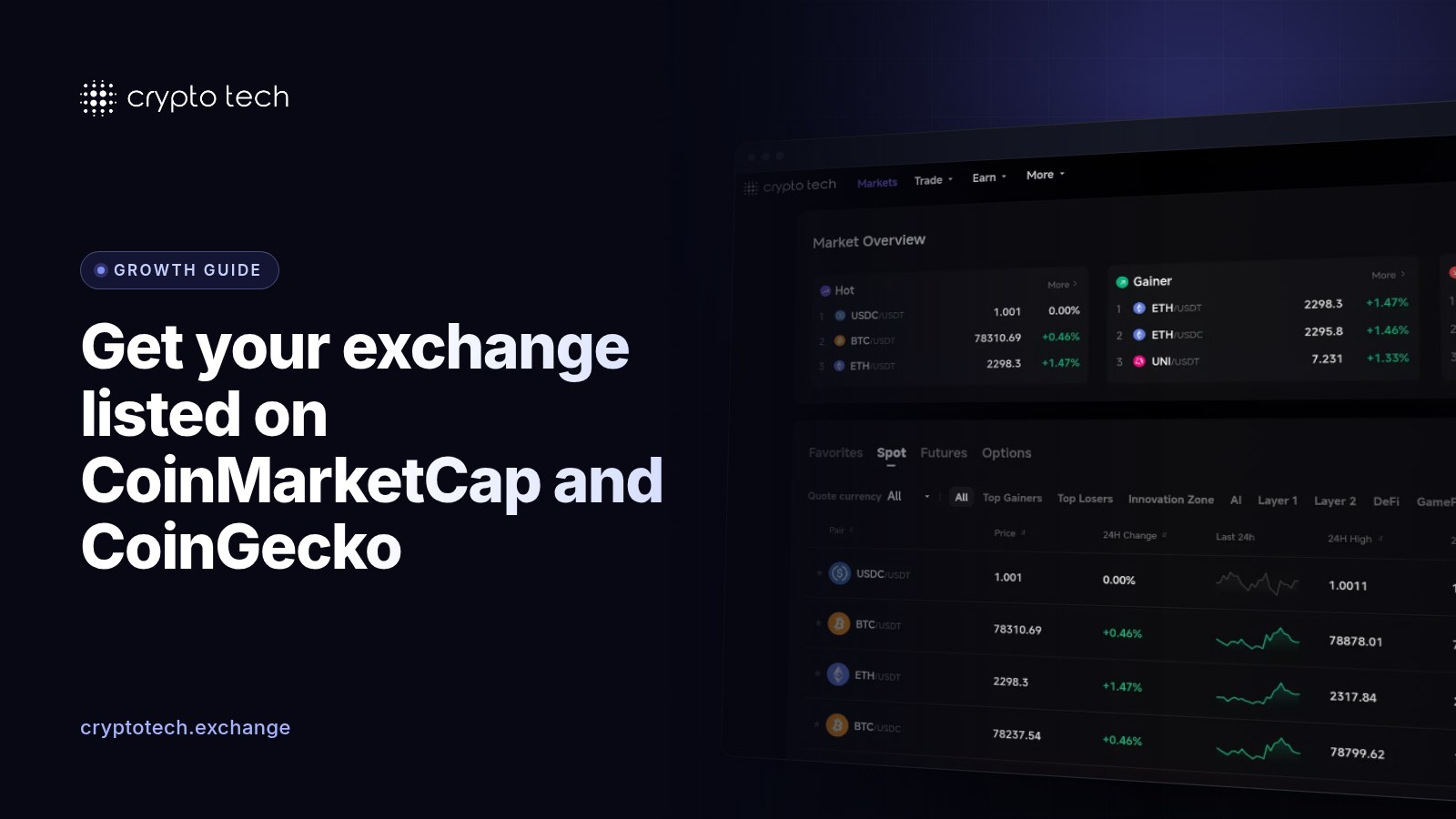
For a new exchange, a page on CoinMarketCap and CoinGecko does three jobs at once. Traders find you when they search for a coin. Projects find you when they look for a place to list. And the listing itself is a signal that your exchange is real. This guide covers what both sites need and how to prepare before you apply.
How the listing works
Neither site enters your prices by hand. They read your markets automatically through a public API, every few minutes, and calculate volume and prices from it. So the process has two parts:
- Technical: your exchange exposes the endpoints each site expects, in the format it expects.
- Review: you submit a listing request, and their team checks that the exchange, its volume and its company are genuine.
The data both sites read
Each site publishes its own API standard, and the field names differ. The content is similar:
| Data | What it contains |
|---|---|
| Markets or pairs | Every trading pair, with base and quote currency |
| Tickers | Last price, 24-hour volume, high, low and best bid and ask per pair |
| Order books | Bids and asks to a given depth, used to judge liquidity |
| Trades | Recent trades with price, amount, side and time |
| Assets | The coins you list, with deposit and withdrawal status |
Futures exchanges also expose contract data such as open interest, funding rate and index price, which both sites show on their derivatives pages.
What the review team looks at
Requirements change, so always read each site’s current listing criteria before applying. In general, reviewers look for:
- Genuine volume. Both sites use order book depth, web traffic and trade patterns to spot wash trading. Volume that does not match traffic or depth is the most common reason for rejection or low ranking.
- A working exchange. Sign-up, deposits, trading and withdrawals that actually work.
- Transparency. A company name, contact details, terms of service and fee schedule on the website.
- Stable data. Endpoints that respond reliably and agree with what the website shows.
- Proof of reserves or wallet addresses, increasingly requested for larger exchanges.
Prepare before you apply
- Test every endpoint with public requests from outside your network. Check that prices and volumes match your website exactly.
- Make sure order books have real depth. Our guide on fixing an empty order book covers the options.
- Publish your fees and trading rules on public pages.
- Prepare company documents: registration, licence if any, and a contact person.
- Prepare branding: a square logo, a short description and links to your social accounts.
- Apply through the official forms on each site. Be wary of anyone who offers a paid “guaranteed listing” through a back channel.
Common reasons for rejection
- Volume that looks generated, such as perfectly regular trades or volume far above order book depth.
- Endpoints that time out or return data in the wrong format.
- No real users: a site with almost no traffic but large volume.
- Missing company and contact information.
After the listing
A listing is not the finish line. Both sites rank exchanges by trust, liquidity and traffic, and the ranking decides how visible you are. Keep endpoints fast, grow genuine volume, and keep your coin list and fees up to date.
How CryptoTech helps
Every CryptoTech exchange ships with the endpoints both sites ask for, from the Basic package up. CoinMarketCap gets its market list, tickers, order books, trades and assets. CoinGecko gets its pairs, tickers, order books and historical trades. The data comes straight from the same engine that powers your trading screen, so it always matches. Read more in crypto exchange API.
Frequently asked questions
How long does a listing take?
It depends on the queue at each site and how complete your application is. Prepare everything above first so the review is not delayed.
Do I have to pay to be listed?
Both sites have free listing processes. They also sell advertising, which is separate from the listing itself.
Can I apply right after launch?
You can, but an exchange with real users and steady volume has a much better chance. Many operators wait until they have a few weeks of genuine trading history.
See what else a new exchange needs in our guide to starting a cryptocurrency exchange in 2026.